**Title: Embracing Diversity: Why Most Americans Favor a More Inclusive Society**
**Subheading: Unpacking the Growing Desire for Ethnic and Religious Diversity in the U.S.**
In today’s rapidly evolving society, the concept of diversity is taking center stage. Recent findings suggest that the majority of Americans embrace a more ethnically and religiously diverse environment than what currently exists. This significant trend reflects a desire not only for inclusivity but for a future where differences are celebrated and leveraged.
### The Numbers Speak Volumes
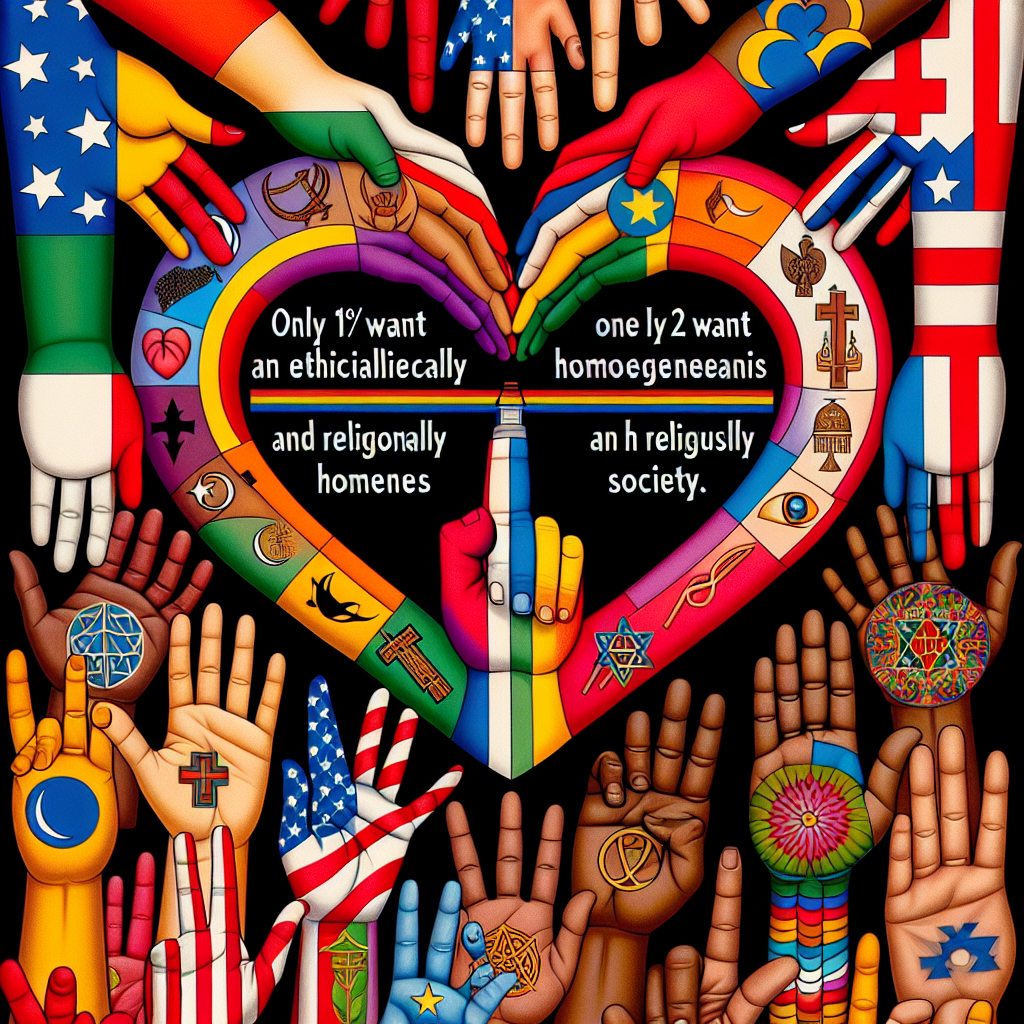
A mere 1.1% of Americans prefer an ethnically homogeneous United States, while only 3.2% favor a religiously homogeneous society. These tiny fractions signify a broad consensus across the country: diversity is not just accepted but actively desired. Americans are increasingly recognizing the cultural richness and innovative potential that diverse perspectives bring to the table.
### Why Diversity Matters
So, why is there such a strong inclination towards diversity? Ethnically and religiously diverse communities tend to foster environments where creativity and innovation can flourish. Diverse groups can provide a broader range of ideas, improving problem-solving capabilities and fostering more inclusive decision-making.
Furthermore, exposure to different cultures and beliefs encourages empathy and understanding. This can help reduce prejudice and discrimination, paving the way for a more harmonious coexistence among communities.
### The Benefits of a Diverse Society
Beyond social harmony, diverse societies offer numerous tangible benefits. A study by McKinsey found that companies in the top quartile for ethnic and racial diversity in management were 35% more likely to have financial returns above their respective national industry medians. Similarly, gender-diverse companies are 15% more likely to outperform their peers.
More diverse communities can also lead to greater resilience and adaptability. In a globalized world, the ability to understand and interact with various cultures is invaluable. Such skills help in navigating the complexities of international business and diplomacy.
### The Path to a Diverse America
For the United States to continue on this path, it is crucial to implement policies and practices that support diversity and inclusion. This includes enhancing accessibility to resources across different communities, promoting diverse leadership in various sectors, and encouraging cross-cultural education and experiences from an early age.
Additionally, media representation plays a vital role in shaping perceptions and attitudes towards diversity. By ensuring diverse voices are heard and seen, media can help mold a society that is more understanding and accepting of each other’s differences.
### A Diverse Tomorrow
In conclusion, the overwhelming desire among Americans for a more diverse society signals a shift towards a more inclusive and forward-thinking nation. By nurturing this trend, the United States can harness the power of diversity to build a stronger, more innovative, and peaceful society.
As individuals, we can contribute by celebrating differences, engaging in meaningful dialogues, and fostering environments where everyone feels valued and included. Through collective effort, America can continue to be a place where diversity isn’t just a goal but a reality.
 Trend Engine: AI-Powered News & Trends